Major Project: Tristan Barber

Beyond Yesterday’s Grasp: A Disability Perspective

Project Writeup

In this project, I analyzed one of Watercress’ (my game development studio) previous games, Beyond Yesterday’s Grasp, from a disability perspective. Beyond Yesterday’s Grasp follows a disabled POC main character and her trans partner as they solve a ghost’s murder mystery. This project came in three distinct parts.

The Process:

The first part was an initial playthrough of the game, taking roughly three hours, with a write-up based on initial impressions and further breakdown with disability and intersectionality as the focus. While this is a choice-based game, for the sake of brevity, the “true ending” is the focus of the paper and the initial playthrough. During my playthrough of the game, I wrote down notes on certain factors of representation, with particular respect to dialogue and interpersonal interaction between the disabled, trans, and normative characters within the story. 

The second part involved an interview with one of the original writers and leadership on the project, over roughly two hours. This writer is a disabled trans person, offering unique insight into the intended final product and representation within Beyond Yesterday’s Grasp. This interview largely centered around the intent of the initial project, the development cycle of the game, the representation within the game, and the personal connections between the diverse team and the project they released. An abbreviated text write-up of the interview was included, and this interview helped inform the end product of part one’s game breakdown. For the sake of context, I will place the interview first before the analysis in this post.

The third part involved running through an accessibility checklist, which is also provided, with a short write-up on how the game rated, and on accessibility as a whole within the industry. This checklist was provided by GAG (Game Accessibility Guidelines), a website with numerous resources for making a more accessible gaming industry. The checklist was then modified by my studio’s programming department, removing accessibility requirements that do not pertain to visual novels. This primarily takes controls and content into consideration, and the ultimate write-up goes into further detail on the rating I give the game, and why the game came to have that rating. From there, I explore why many games have similar ratings, with a short explanation of how inaccessible games are, and why. I have also included a link to an accessibility talk I gave at an industry event last year, as a resource for all to use. 

Goals:

My goal for this project was simple: Explore a project my studio produced through a disability perspective, gain further understanding of representation and intersectionality, and determine where the project may have fallen short, with the intention to use this project as an opportunity to improve disability representation and accessibility in all of my future projects. After much reflection, my approach to representation and accessibility has changed, with a greater focus on both factors for all future releases. In particular, ensuring the development of projects allows time for disabled workers, and that all games meet a minimum requirement of accessibility before the final release is even considered. Likewise, much of this was unknown to me until now – disabled voices are often unheard even unintentionally, and ensuring they are heard will be a prerequisite for all future projects of mine in the future.

Developer Interview

Can you give me a brief introduction to who you are, what positions you held on the project, and what parts of the development cycle you contributed to?

“I am Penelope X. Pilbeam, and I was originally a lead writer on Beyond Yesterday’s Grasp. I was eventually escalated to Co-Lead on Beyond Yesterday’s Grasp. I also did a lot of the scripting, some of the editing, really every corner of the game has some of me, for sure – including [some of] the art assets ’cause I did create a ton of those myself.”

This game follows a disabled woman of color and a trans man as they navigate difficult social and paranormal situations – was any of the narrative pulled from developers’ personal experiences?

“Yeah, obviously none of us have a missing limb – none of us are amputees that I know of, but Ginger [The Project Director] was someone that had a lot of chronic pain, obviously I have a lot of trauma in my own life that went into the character, so Alex as a protagonist had a lot of pathos from both of our lives that sort of blended together. Ginger talked a lot about how her health problems were pretty scary, her chronic pain that I don’t think at the time she had an explanation for – I don’t remember, but the only thing that she could do was take Ibuprofen, and eventually she’d become immune to Ibuprofen so it was a countdown, which was scary for her. So, that went into a lot of Alex’s characterization.”

“Chronic pain looms much larger in Alex’s life than the fact that she’s missing an arm, because the idea was that she was really fucked up by being in this car accident, and so, the trauma was more than just the visible, it was the invisible, it was her body and then her heart – she was genuinely fucking traumatized by this horrible accident she was in, so that was the idea. You can actually see in the game, very little of Alex’s pathos as a character is in the fact that she is literally missing her arm, outside of the fact that that’s how her powers work. Most of it is rooted in her unseen damage, that stuff that is unrelated to her amputation.”

In working on a month-long project, how did you and the other writers prepare for the topics and people you’d eventually be representing in the game?

“I think that obviously we wanted to design these characters, so Alex went through a lot of different permutations as we went along. We started out conservatively, we didn’t know how liberally we wanted to go with the framing of the story – obviously Ginger and I are pretty leftist, we were both on Tumblr a lot during 2014, so we didn’t want to do a story about a bunch of white people, we wanted a diverse cast, so we were trying to figure out how far we could push that envelope without it seeming overwrought or unbelievable. To some degree, Alex being an Indian-American was because she was based on an actual person – the actress who played Mara in House of Anubis, which Ginger drew from liberally to create her proposal originally. We wanted our character to look like that one, even though Mara wasn’t the main character of House of Anubis. That was the main reason why she was Indian, and not like Mexican or something like I am – because it was based on that character, a reference of that character.”

“Caelum, was again, based on some guy from the show originally – someone that Ginger liked a lot. That character was a major part of her original proposal, so it was always kind of a done deal that he was going to be in the game, but I was trying to figure out how to make him more interesting than just a straight guy, so we decided on him being trans because it just made sense for the character, especially given the overarching theme of traumatic pasts and baggage from “yesterday”. So, that was really important for us. I don’t think I would have enjoyed writing Caelum nearly as much if not for the fact that we did make him trans. So we did stuff like that, figuring out how we could persuade ourselves to like these characters and be interested in them, and it just went from there.”

“Basically, we had these characters, and we created Genevieve, she’s the one “normal”  person in the game – normal in the sense of privileged – the kind of person you’d expect to see in these sorts of stories, the person that’s always cast in any ghost story visual novel. She’s the one character that is a privileged, white, cis girl – of course, she’s a ghost, and she’s kind of a villainess in this story, so it’s interesting that way, and that dynamic is interesting, and comes into play in that story. It was really just a matter of hashing out these characters, their beef, their various traumas and such, and developing a story around them. It was meant to be a very character-centric story, we weren’t going to do just a ghost story, it was plotted more like how a CW show would be plotted. Lots of relationship drama, family drama, stuff like that.” 

What inspired the concept behind the project, and considering the month-long development cycle, how well do you feel that the finished product reflects the original concept?

Given more time, would you have changed anything?

“[It drew inspiration from] House of Anubis, it was a Nickelodeon show, part of the teen-targeted Nickelodeon programming, dealt with slightly more mature themes, but still very much a Nickelodeon show, paced and scripted like one. Ginger was, what 19? She was young. With our age difference definitely came different approaches to how we wanted to write the story, even though we were very simpatico. I had watched the show at her behest, to better understand her creative vision for this game – it was her proposal, I wanted to create something that she felt like she had been the architect of. I wanted to have a firm grasp of what she meant, what she was trying to accomplish, what vibe she was trying to go for.”

“I wasn’t trying to go into business for myself with this VN, I was trying to help Ginger make her vision reality. So, while I do feel like I wound up having way more of a practical role in making the game happen, the intent was always to make Ginger’s game. It was a matter of Ginger taking on more than she could handle as an 18-year-old who was doing college at the time, and me being a much more experienced VN developer, who was much older and had much more free time on her hands. While I do feel like I created most of that game, I feel like I created it to spec. It was never about me, it was about Ginger – so when Ginger had to withdraw towards the end of development because of her own health problems, and because of her life, I do feel like most of the game ended up being my creation – but again, I wasn’t trying to create my own VN, I was trying to make her’s. She was the lead writer, the director of the project, but it wound up being very different from how it would have turned out if she had done all of the things I had done for her, very little would have stayed the same.”

“If I had a year to work on this project, there would have been more characters, the gameplay aspect would have been longer, we created more for this game than we wound up being able to put into the game. We only had so many voice actors, so many artists, they could only draw so much – it wound up being a very self-contained game with a very small cast.” 

Alex, the main character, communicates through her missing arm into the realm of the dead. What was the inspiration behind this choice? Are there any other aspects of Alex (and Caelum) that you want to highlight?

“Actually, I will tell you what the inspiration behind that choice was, because it’s very interesting. A long time ago, many many years ago, I had a concept for a deconstructive Harry Potter fan fiction – it was a parody of what they call a Peggy Sue fic, which is when somebody goes back in time in their own body to do a choice differently. I had the idea of this character who was Harry Potter, who had gone back in time to inhabit his childhood body, but wound up not being incarnated into the right body – basically, it was a commentary on the ethical ramifications of killing your past self to take over their body, and so, he misaims his spell to go back in time to change the future, instead of taking over his own body, he takes over the body of Pansy Parkinson or something, ’cause that makes it more starkly clear how fucked up this concept is. At one point, he was going to try and acquire his old wand, and so he touches it, and he creates a paradox universe reaction, and his arm explodes – Pansy’s arm explodes – and leaves him with a stump. The moment he touched the wand, he killed the possibility of himself in the future existing. He destroyed that timeline, which killed him, which means he’s now a ghost inhabiting a body. The whole thing was that he was going to have an arm that was a ghost arm because he’s a ghost possessing a body.”

“Obviously I never wrote that fanfic for many, many good reasons, but I had had this idea of an arm that is thrust in the realm of the dead. They’re missing their arm, but they have a ghost arm, it’s vestigial, and it can manipulate the spirit world the way that a normal arm manipulates the physical world. This gives Alex the power to affect both – which is why she’s such a powerful character. That arm was reflective of the fact that even though she is alive, she has been through enough trauma that she’s partially a ghost. ‘Cause ghosts are souls left restless from trauma, she has enough trauma that if she had died, she would be a ghost. But she did not – she did blow her arm off – and she’s an aberration because of her being stuck in two different worlds. In the wall between the living world and the spirit world, there’s a hole and her arm is stuck in it and she can’t take it out. That’s how that idea evolved. […] I had actually written so much, I wound up drawing so many ideas from that outline for other projects that I have worked on, like ontological ideas of being alive, and death in the soul, strength in the soul, the qualities of the human soul, these are all things that I had been thinking about as a worldbuilding thing, and so, for Alex, I had had this idea lying around unused, so why not give her that power? That’s how she wound up having it.”

“Caelum was much more easy to design, ’cause Caelum was much more Ginger’s character, which is why Caelum is so simple, because Ginger doesn’t go as wonky into the weird ontological existential weirdness as I do. This is a genuinely good guy, who happens to be trans, and has a bad relationship with his parents, and that’s it. He was raised catholic, obviously that informs a lot of his pathos. The one thing I will say with Caelum is that, even though he was always envisioned as a trans man, it was a stroke of luck that he wound up being voiced by a trans man actor, because not even Maxi (Voice Acting Director) knew at the time that his friend was a trans man, so it kind of fell out that way. And we didn’t know it until after the game came out, and he was like, “this was my first time actually getting to voice a trans man like myself”, and were like, “wow, we’re really fucking glad you voiced the character.”

It’s been nearly four years since the release of this project, and a lot has changed since then – do you have any thoughts on contemporary media representation of underprivileged and marginalized groups?

“It’s trickier than it used to be – it is less obvious, now. People want representation in games, but they won’t simply go support somebody’s work just because it has marginalization in it. So, that’s a thing. You can’t simply market a game based on, “oh hey, it has a trans man character in it” because that’s not enough to motivate people. You have to do that, you can’t opt out of it either, but you have to do more than that – that on its own is not enough to impress people. It’s hard especially because, I want to write stories about trans people – absolutely I do – but I don’t want to write stories that are about just being trans and transitioning, as my transition was almost a decade ago – I’m over it. I just want to see characters like me doing cool things in stories I like, I don’t want to read my one-millionth trans character figuring out they’re trans, coming out of the closet and doing all of the shit I did ages ago that I’m over, I want to see trans people be heroes and shit, I want them to be in genre. I don’t want to just tell transition narratives, ’cause they bore the shit out of me. I know that a lot of people are less far along than me and they want to read those, and maybe they will never be tired of those, but for me, I’m done.”

“We’re coming up now on a very electrified third rail, about the proportion of trans male representation in games and in fiction versus trans female. Look at the new Star Trek show – “Hey we’re adding two trans characters to the cast!” and both were assigned female at birth, one was nonbinary but both were AFAB actors. It’s like, okay, you’re not representing me. These are characters that are self evidently not trans women. But you think you have completed your obligation to represent us with these characters who are not us, and obviously trans men frequently believe the opposite, they believe that trans women are hyper-visible – they’re right, but we’re hypervisible as boogeymen that people want to murder. It’s not really like we’re getting positive representation. When a trans man is represented in fiction, it’s usually fairly well – you simply cannot say the same about trans women. I think that’s part of the problem that’s been going on, part of the discussion. What is good trans representation? No one is ever going to be happy with trans representation because none of it is enough, but there’s a lot more intra-community strife based on the subject. I didn’t mind in 2018 when we did Beyond Yesterday’s Grasp, I was like, “Hell yeah I want Caelum to be a trans man” and I wasn’t thinking like, “well yeah let’s have a trans woman”, like “there must be one”, I want this character to be a trans guy. Nowadays, I don’t know if I’d do that – I love Caelum – I just think that my priorities would be different, my sense of what I would feel comfortable writing about would be different, so, it would just be different – I would be coming at it from a different emotional place, with different objectives as a writer.”

Lastly, do you have any writings or projects in the works, or anything you would want to point readers to?

“I do have my Patreon, but the next big thing I’m hoping to get done for Watercress [our studio] is that anthology series, I still plan on doing that as a Christmas present – it’s a fun exercise to write fanfiction essentially for these old games, these epilogues basically, that celebrate the past. I’m working on Avitus, and that’s basically it for now.”

[Note: The anthology series is a series of epilogues for old games we developed in the past. Avitus is our flagship project, of which more info can be found on our studio Twitter, linked below.]

Links to Penelope’s Patreon here: https://www.patreon.com/nymphomachy

Watercress’ Twitter here: https://twitter.com/teamwatercress

Impressions and Breakdown

Beyond Yesterday’s Grasp, a game developed by Watercress, is an excellent case study in the interaction between disability representation and the individuals who write such stories. The game follows Alex, a disabled Indian-American, who reaches into the spirit world through the use of her amputated arm. She, alongside her trans-masc friend Caelum, solve a murder mystery in their dorm, ultimately fighting off a dangerous wraith and living to enjoy their lives together. In reading this narrative, and in deconstructing the representation therein, the representation of each of the characters is ultimately progressive. This is determined through the interpersonal relationships within the story and the narrative operation of the prosthetic arm in the plot – all given great perspective by the individual experiences of the writing staff.

When exploring the relationships between the two lead characters and the rest of the cast, three points of contact are worth deconstructing: the relationship between Alex and the dorm mother Jianmei, Alex and her co-lead Caelum, and Alex and the ghost Genevieve. Each serves to highlight different perspectives on disability, race, and gender, culminating in a diverse representation of the problems trans and disabled people experience in contemporary society.

The interactions between Alex and Jianmei, the house mother, represent the “well-meaning” normative reactions to disabled people. Their very first interaction, where Alex arrives with luggage at her new dorm in Act 1 Scene 1, follows as such:

Jianmei: "Do you need help with your bags?"
Alex "N-No thanks; I've got it."
Jianmei "No, seriously! I can help! It must be hard with that arm, so I can assist you!"
Alex "You don't need to, please! I'm used to it."
Jianmei "...Are you sure?"
Alex "Yes, absolutely."

From the moment Alex arrives at the dorm, Jianmei pushes this idea that Alex needs to be helped because of her physical disability – her missing arm. While not many would openly talk about the arm – and perhaps giving Jianmei a bit more credit, she does back off eventually – her insistence that Alex needs help because of her disability betrays an infantilization perspective of the disabled. This is largely accurate, something that many people with disabilities must suffer through, despite their ability to exist as adults. This is later expanded upon later in the narrative with Alex noting that Jianmei frequently stares at her arm.

Meanwhile, the relationship between Caelum and Alex gets off to a similarly awkward start, but one that shows the difference in perspective between Caelum and Jianmei. Meeting in the hallway, Alex uses her prosthetic to waive to Caelum, and he responds “I like your… arm?” (Act 1 Scene 2). This faux pas is something quickly worked around by both students, as Caelum eventually normalizes disability and relates with Alex through his own experiences with his catholic family. This is explored through a certain camaraderie – both are underprivileged and marginalized people. Importantly, Caelum, a trans male student, is forced to live in the women’s dorm due to the university’s poor management. This relationship portrays the intersectionality of gender and disability, with both groups being heavily underprivileged and abused by society.

As the story progresses, they confide in each other, with Alex talking of the traumatic death of her parents in a car accident (the same accident that took her arm), and Caelum’s experiences living with parents that hated him for being transgender. When Alex eventually explains to Caelum that she can feel ghosts with her missing hand, rather than doubting her immediately, Caelum jumps to action, asking what he can do to help. This display of trust, and this ability to suspend disbelief for the sake of his friend, shows a deeper understanding between the two characters than they have with the other members of the game’s cast. This is a progressive approach to their portrayal, as both characters avoid tropes and cliches while supporting each other with realistic approaches to their problems.

The last relationship to explore is between Alex and the ghost that plagues her dorm life, Genevieve. As a rich young girl murdered by her father in the early 1900s, she shows the vindictive, capitalistic approach to disability. Alex is a means to an end – only useful due to her ability to interact with the spirit world, and therefore capable of freeing her from her purgatory. When Alex proves to place her own life over the “life” of Genevieve, they have a physical confrontation, with Genevieve attempting to pull Alex away from her work. Here, the intersectionality between race and disability comes to the forefront.

Alex takes a stand against Genevieve, enforcing her agency, and tells the ghost off: “Did you simply assume that because I had brown skin, I’d just be another one of your servants? Piss off.” (Act 2 Scene 6). Genevieve backs off after this, allowing Alex to command her own life, but the damage is done. The ghost, and much of the world around Alex, sees her as something to be used, or thrown away – the worth of a life defined by their use to society at large.

While each of the character dynamics is important for the disability representation in the game, the real meat comes in what the prosthetic arm itself represents. The crux of the story revolves around Alex’s ability to sense and communicate with spirits through her “ghost” arm. In the interview with one of the lead writers, it was revealed that this was a specific choice to highlight the seen and unseen – how the most visible disabilities are not always the most debilitating or life-changing.

Chronic disability is an often underrepresented side of the disability spectrum, one that is incredibly hard to handle respectfully. Media stigmatizes it as drug abuse, depression, suicide – only a sliver of what disability covers. Here, the missing arm is a physical representation of the traumatic event that disabled Alex – the car accident. In this car accident, both of her parents died, and her arm was taken from her. In the same way that ghosts are created by traumatic deaths, a part of Alex was likewise killed, leaving her in the in-between, living in both realities while holding neither as her true home. This representation of disability is progressive, highlighting the importance of disabled voices, as they share unique perspectives that cannot be understood otherwise.

This representation goes deeper than just the narrative. Many of the writers on the project were disabled, especially in the case of the Project Director, Ginger. Suffering through chronic pain from an unknown source, the anxiety over her own worsening condition and her growing immunity to painkillers informed the position Alex would eventually take within the story. Disability, and becoming disabled, can be a terrifying experience, especially if it is the result of an already-traumatizing event.

This holds true with the transgender experience as well. Like disability, it isn’t something that can be “treated”, it’s a unique experience, it’s part of who you are. Like with disabled communities, transgendered people face limited access to important community resources, and have been historically marginalized and silenced. Both Alex and Caelum see this in each other – as did the developers of the project – and the narrative allows them to speak their experience into reality, to gather agency in a society that wishes to remove it.

Works Cited:

  • Watercress. Cautionary Tale: “Beyond Yesterday’s Grasp”. Windows PC version, April 2018. https://watercress.itch.io/cautionary-tale.

Accessibility Write-Up

In playing through the game, I took extensive notes on how accessible the game is to greater audiences, with particular respect to the disabled community. While I believe the narrative is an excellent representation of disability and intersectionality, the game itself falls woefully short in how accessible it is to a wider, non-normative audience. While I have included a checklist going through much of the accessibility options needed in modern games, I will expand upon it here and relate it to general, informed observations of the gaming industry at large. For the sake of brevity, I will explore two important aspects of game accessibility: motor access and cognitive access. This means that I will not be talking on subjects like content warnings and options thereof – albeit those are incredibly important as well.

From the very first interaction with the game, it becomes apparent how poor the accessibility is. The intro cinematic is unskippable, the main menu requires a left click of the mouse to even access, and the UI is poor and visually unappealing. It is a general rule that games like these – visual novels – need to have mouse-only and keyboard-only functionality, and it’s becoming a greater necessity to include gamepad-only functionality as well. This game is marginally accessible with mouse-only, and is completely unplayable in other modes. 

For cognitive access, it isn’t much better. There are no font-change options, and while the text is relatively dyslexia-friendly, allowing for increased text size is a must. Some events in the game include flashing lights that cannot be disabled, and some of the transitions involve fast-moving objects, which also cannot be turned off. Accessing each individual game is an entirely visual process, with no subtitles for each game (as Beyond Yesterday’s Grasp was part of a three-game anthology). Buttons don’t have visual indicators for selection, and some important narrative portions of the game are done through audio only, which is particularly bad.

While contemporary Watercress games handle accessibility better, this serves as a great example of how accessibility is often considered in game development – it’s a stretch goal. Some studios can afford it, but accessibility is often not taken into consideration for pre-flight or pre-release standards. People with disabilities cannot access all of the games that normative people can, and this isn’t something we can blame on the disability – in many cases, if the developers spent more time on accessibility and considered it a foundational part of the game, it would be accessible.

From a personal standpoint, going through the game for this final project was a great exercise. I’ve had the opportunity to see how our games used to be, what our games are like now in comparison, and what we can do to better ourselves in the future. Watercress is already undergoing an accessibility patch for Beyond Yesterday’s Grasp and the anthology Cautionary Tale as a whole, and I hope that other game developers will take the time to look at what they can do better as well.

Link to Accessibility Sheet: https://docs.google.com/spreadsheets/d/1IIomb-CFSuylxE4wfzry3hCjFy0LQ_UsKrJ9511q0vY/edit?usp=sharing

And, as promised, here’s a link to the accessibility talk I gave last year: https://www.youtube.com/watch?v=RcFHcRyErTw

“I hereby declare upon my word of honor that I have neither given nor received unauthorized help on this work.” ~Tristan Barber

Deprived of Resources

By: Mary Ainsley Fox “I Pledge”

Word Count: 1788

The portrayal of disabled people in our assigned readings and even in our world today seem to not receive the same amount of resources they may need and/or would benefit from. Dating from years back, the disabled population have been seen as sins, collateral damage in a sense, and a “freak of nature.” Back in the day, a person with physical disabilities was seen as God striking down on them and their sins in the past life. Another excuse and honestly a complete insult is that God gave two flawed people who have made numerous mistakes a child who has disabilities. Some people would try to hide their child due to “public humiliation” and this was yet another obstacle the children would have to bear. Three of the main topics that this paper will be focusing heavily on are To Kill a Mockingbird, Of Mice and Men, and the infamous Coronavirus pandemic. Although many different portrayals of disabled people have constantly been negative in film, literature, etc., we as a community have seen their basic needs not being met through a global pandemic that would sweep the world off their feet. Throughout history, we can see the change of the definition of “disability” and the different verbiage going along with that. For example, people of different ethnicities, culture, and skin tones were treated as if they were ostracised from society, treated like they had something “wrong” with them. Perspectives constantly switch from a time of unpredictability, loss, and devastation to a time of change, different outlooks, and bettering the future. Whether it be a physical, educational, or mental disability, our society tends to ignore basic resources needed. Three specific themes that are recurring are unpredictability, loss, and devastation and are seen throughout history. Although a majority of the human population has gone through the action of fighting these themes, disabled people have been the biggest victims of impact. 

In the very famous, banned book Of Mice and Men by John Steinbeck, the two main characters are George and Lennie. These two ranch workers are in search of new and better opportunities for jobs. Throughout their journey, Lennie is obsessing over the “perfect life” with George. “Behind him walked his opposite, a huge man, shapeless of face, with large, pale eyes, with wide, sloping shoulders; and he walked heavily, dragging his feet a little, the way a bear drags his paws” (Steinbeck 2). In this quote, we can see how Lennie was described as a literal animal, as some people with disabilities (and people of color) were expressed to be. He was described to have no human features and to have one that comes very close in comparison to almost a zombie. Although he appears to be a fit male, his disability is within and the audience can concur that he has some form of intellectual disability. Early on in the book, we witness an encounter between the two ranch workers and Lennie asked George where they were going. George yelled back and said “So you forgot that awready, did you? I gotta tell you again, do I? Jesus Christ you’re a crazy bastard” (Steinbeck 4). Obviously, Lennie cannot remember or grasp a simple concept, such as where they are headed to and instead of reminding him, George angrily calls Lennie a “bastard” and does not really give him a chance. All his life, Lennie has probably been called inhumane names and derogatory cuts at his own being. Lennie was obviously deprived of a better education where he should have received a tutor and extra help in school, but did not have the right resources. Later on, Lennie is unable to control and/or cannot seem to “correctly” feel how he feels. Although he is a tall, strong man, who wants the best for he and Goerge, he commits murder. He is a lover of soft texture items and while he is clearly upset, Curley’s wife goes up to him for comfort and allows him to play with her hair. The feature of long hair has always been symbolic of femininity and also serenity. Lennie becomes very overstimulated and he does not know his own strength. He shakes her head so hard, it kills her. “Lennie never done it in meanness” (Steinbeck 90). George said this in hopes of saving not only Lennie, but his own reputation as well. After killing Curley’s wife by accident, George was in disbelief that Lennie was capable of killing another human being. The killing of Curley’s wife ultimately led George to kill Lennie, because he was afraid what would happen if others found out. 

In To Kill a Mockingbird, Boo Radley is neighbors with the Finch family, where he seems to hardly be seen. He is consecutively hopping in and out of the picture, when he wants to be seen. Mr. Finch, Atticus, is having a conversation with Scout telling her that basically if she learns to sit back and learn to understand why people are the way they are and to walk a mile in their shoes, her life will be a whole lot less worrisome (Lee 33). A simple lesson we have all been taught could be so important it could save someone from a deep form of loneliness, depression. If someone would have taken the time to understand why Boo is the way he is, then maybe he would have more people to lean on and he would feel more comfortable in his own skin. Based on his tendencies such as hanging out with the younger generation (Scout and Jem), Boo seems to have a more innocent personality than others his age. Another “disability” seen in this book is the color of Tom’s skin and his social placement is used against him under the law. For example, it states that “Maycomb’s Ewells lived behind the town garbage dump in what was once a Negro cabin” (Lee 193-194). This is a prime example of how underprivileged Tom was by the law and society that he does not “deserve” the same, clean, sanitary treatment as those around him. The Ewell family is on the outskirts of towns and on the outskirts within the society.    

Lastly, I think we can all agree that the Coronavirus swept out America and the world as a whole more so than what we were expecting when it first hit. Not only were people with physical disabilities out of reach of basic needs, such as private tutors, rehabilitation centers, and therapists, but money was another component that ran out. Workers ran out of their jobs and this would later lead to a time of uncertainty within their families. During quarantine, women and children were trapped in homes being abused everyday, but had no resources for therapy and they felt as if there was nowhere to go. With the closing of schools across America, the school system became one of uncertainty and unpredictability. Teachers had to relearn how to teach online and they also had to learn to work from home. Students had to learn to be away from friends, teachers, and tutors. The children who were learning online did not receive the education they should have, especially at elementary aged students. Not only was their education missing, but their opportunity to socialize became lost. For younger children, they are at an age where socializing is just as important as going to school and both of these concepts were taken away from them. Many people still suffer the consequences of quarantine due to major health issues that were impacted. People were losing jobs left and right, parents and children were unable to support their families, and health became a dire priority. This virus hit the world like a scene from a movie, children became orphaned, parents became childless, and the world became hopeless. The future held empty promises for many people, but especially those who were impoverished and those who simply did not maintain the same financial status as others. Health care and health insurance would soon be a luxury for most of America and other countries as well. Underlying health factors would also be an important component with the Coronavirus. For example, if a victim has respiratory issues and they become ill with COVID, they will most likely be put on a ventilator.  

Most disabled people are continuously in need of more attention and different forms of resorts. People of all ages, genders, and societies could potentially benefit from different forms of centers. Our society today is trying to combat different judgements against the disabled community, such as certain verbiage (ie. getting rid of the “r” word) and teaching to the younger generation that “disabled” people are actually just abled people who go about life a little bit differently. The disabled community could be due to lack of funding, circumstances, and nature at the end of the day. Many different students may feel a sort of shame that their peers are getting ahead faster and/or a little bit easier in the classroom than they are, but with resources life becomes easier. The right tutors can change a students life upside down, but affording a private tutor may not be an option for most students. However, some colleges offer free sessions with a private tutor who is usually a fellow student. People who may have a physical disability, such as those who have Tetra-Amelia Syndrome may feel as if they do not have the same standards as the peers who are not able to relate. Tetra-Amelia Syndrome is a disorder for those born without any of their limbs. However, with the right support system and those around them pushing them to be the best they can be, they can go on to have families of their own, jobs of their own, and they can even participate in the special olympics. Life for them may not come as easily as it would for someone born with all four limbs, but they are still able to do everyday tasks that everyone else is able to do. Lastly, mental disabilities should be handled with the same amount of care and gentleness as any other disability. A mental disability is a constant battle in your own mind, such as depression and/or anxiety. Getting out of bed each morning may be a struggle, while to an able mind it may just be an expectation, an easy, everyday task. Numerous people each day are deprived of necessary resources that could, at the end of the day, be the reason for successful living. To Kill a Mockingbird, Of Mice and Men, and during the deadly Coronavirus, we are exposed to the lack of aid out there for our society all throughout the past. 

Works Cited:

Lee, Harper. To Kill a Mockingbird. New York. Harper Collins. 2006. Print

Steinbeck, John. Of Mice and Men. New York: Penguin Books. 1937. Print

Major Project: Of Mice and Men Vision Board


Brieanna Smith
Professor Foss
English 384
14 November 2021

Major Project: Of Mice and Men Vision Board

“I hereby declare upon my word of honor that I have neither given nor received unauthorized help on this work.”
Brieanna Smith

Word Count: 1,264 (Not including the title and information required for an essay)

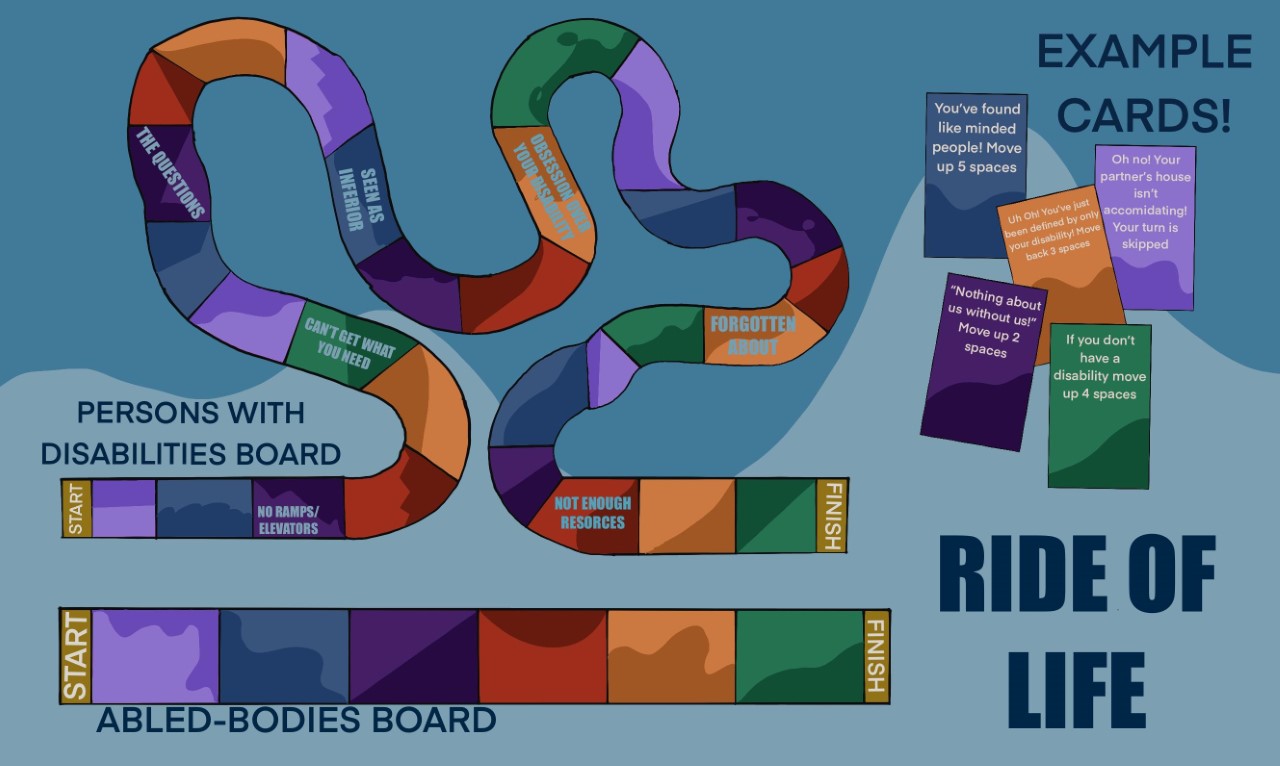
The major paper/project is crucial to our comprehensive analysis of text and how disability studies play a role in that text. Of Mice and Men was a requirement during my freshman year of High School and we primarily focused on the idea of the correlation between race and socioeconomic status in the 1930s. With this novel being set in the 1930s, the idea of the American Dream seemed to lose its luster. Although in this class, we approach this book with a more in-depth analysis of disability aligned characters and how the surrounding environment impacts these characters. My project works to incorporate the shared, American dream of Lennie and George in the form of a Vision Board. In this write up, I will also describe the process of creating this vision board. In the novel the environment that is considered “disabling,” is founded in a perception of normalcy where flawed characters reflect trends within society. We will also discuss the Fries Test when it comes to deciding if our disability aligned characters pass or fail.
The shared American Dream of George and Lennie was focused on working unfulfilling jobs and making wages until they had enough saved to buy a couple acres of land. In my project, I set up the vision board like a timeline that portrays the influence of our characters’ physical surroundings and affects whether or not they achieve their dream. At the top of the project, I set up the end goal that George and Lennie wanted to achieve. I included quotes from when our characters discuss how they are different from everyone else, three-dimensional objects to bring the vision board to life, and photos and stickers that represent a progression and organization of events. In the process of creating this vision board, I used the images and footsteps to show how George’s personality is more detailed and goal oriented. In choosing objects, I hoped to show how Lennie is more free-spirited and enjoys nature specifically rabbits. Another reason I chose certain objects was because they appeal to Lennie’s sense of touch which is mentioned a various times throughout the book. I also included the environment and experience these characters must undergo by drawing their journey through an antiquated map image that shows a potential journey through the Midwest, beginning with them escaping Weed, going to the Ranch, and lastly the possibility of the farm.
In the top portion of my vision board, there are all different breeds of rabbits, alfalfa for those rabbits, a vegetable garden, striped cats, a smoke house, a kitchen orchard, chickens, and cows for fresh milk. The middle portion of my dream board shows the character’s time at the ranch. For this section, I wrote the names of the characters at the ranch, showed Candy’s Dog, the puppies (a sticker and a plush dog), and a picture of how hairstyles were done in the movies in the 1930s to represent Curley’s wife. Candy’s Dog is where we see the perception of age as disabling to what society validates as “the able-bodied employee.” I wanted to indirectly include this detail because it brings to light how complex disability in literature truly is and making assumptions can be damaging to the overall intent of disability studies.
As we see throughout the novel and what I tried to incorporate in my project was the idea that the socioeconomic environment of our characters can be considered “disabling” to the growth of our characters. In my vision board, I map out a potential route that Lennie and George took from Weed to the Ranch, and to their future place one day. Let’s address how our character’s environment could be damaging to Lennie and George. The journey that George and Lennie must take from Weed to the Ranch is one rooted in fear and hiding and this creates a negative atmosphere to begin with. Lennie even offers to live in a cave so George would not have to take care of him anymore. The role of George as a friend and some say caretaker is an incredibly important one because Lennie feels safe around George especially when they talk about their dream. Their time at the ranch in the viewpoint of George is a necessary evil because they need the money to get the farmhouse, but it is not a place that can be trusted. There is even an interaction between George and Lennie where Lennie tells him that he doesn’t feel safe here or doesn’t like it here. Both our characters throughout the novel are either concerned with the financial or physical security of this middle ground. Lennie feels safe in the instance of the puppies and how if he can take care of one, he will be able to take care of the rabbits but does not feel safe in his interaction with Curley. George feels a lack of security when it comes to their plan. He wants to ensure that every detail is set in place, their finances, leaving the Ranch, and including Candy in the plan. Since George is a friend to Lennie, we see him worry about how Lennie is perceived by outsiders and tries to reassure other characters that Lennie is not mean, he just doesn’t understand the impact of his actions. In this explanation, I am not saying whether this is right or wrong, but it is just how I comprehended this part of the book.
Lastly, we will discuss The Fries Test and how it relates to our story. As most of us know, the ending of the book can be perceived as tragic. Before I continue, there are spoilers ahead which I am sure most everyone in this class knows, our characters in this novel do not pass The Fries Test. I wanted to make a correlation between this novel and the seminar I attended with a keynote speaker being Kenny Fries. “The Fries Test,” focuses on what role characters who are disability aligned have within movies, tv, and literature. In our book, none of our characters passed this test; they were either killed off or used to move the story along. Lennie was killed and I subtly show this when the footsteps and yarn go off to the side. Crooks named for his disability brought up the intersection of race and disability in a brief interaction with Lennie, but there was not a significant amount of progress for his character. Candy who experiences a disability based on his age and injury hopes to participate in the dream of George and Lennie, but it never worked out. Finally, George killed someone he considered a friend and that is tragic in and of itself. If he was not a disability aligned character to begin with, hypothetically, he may be now due to the emotional and psychological toll of this action.
I will admit this was a significantly long write up for my project, but there is so much to unpack regarding disability that I hope I accomplished in my project. I wanted to present George and Lennie’s dream in a way that focused on both their personalities, their environment throughout the story, and how close they came to realizing their dream. Although, realizing their dream never happened due to societal expectations and how people with mental and physical disabilities were treated. I hope that I created a vision board that does their dream justice because Lennie and George should have been able to realize their dream, and I wanted to create a representation that shows how beautiful their dream was from the beginning.

Works Cited
Fries, K. (2021, October). Disability Awareness Month and Gender & Sexual Minorities & Allies cultural celebration. Keynote Speaker.
Steinbeck, J. (2010). Of mice and men. Distributed by Paw Prints/Baker & Taylor.

Major Project – Alex Huber

Word count: 547

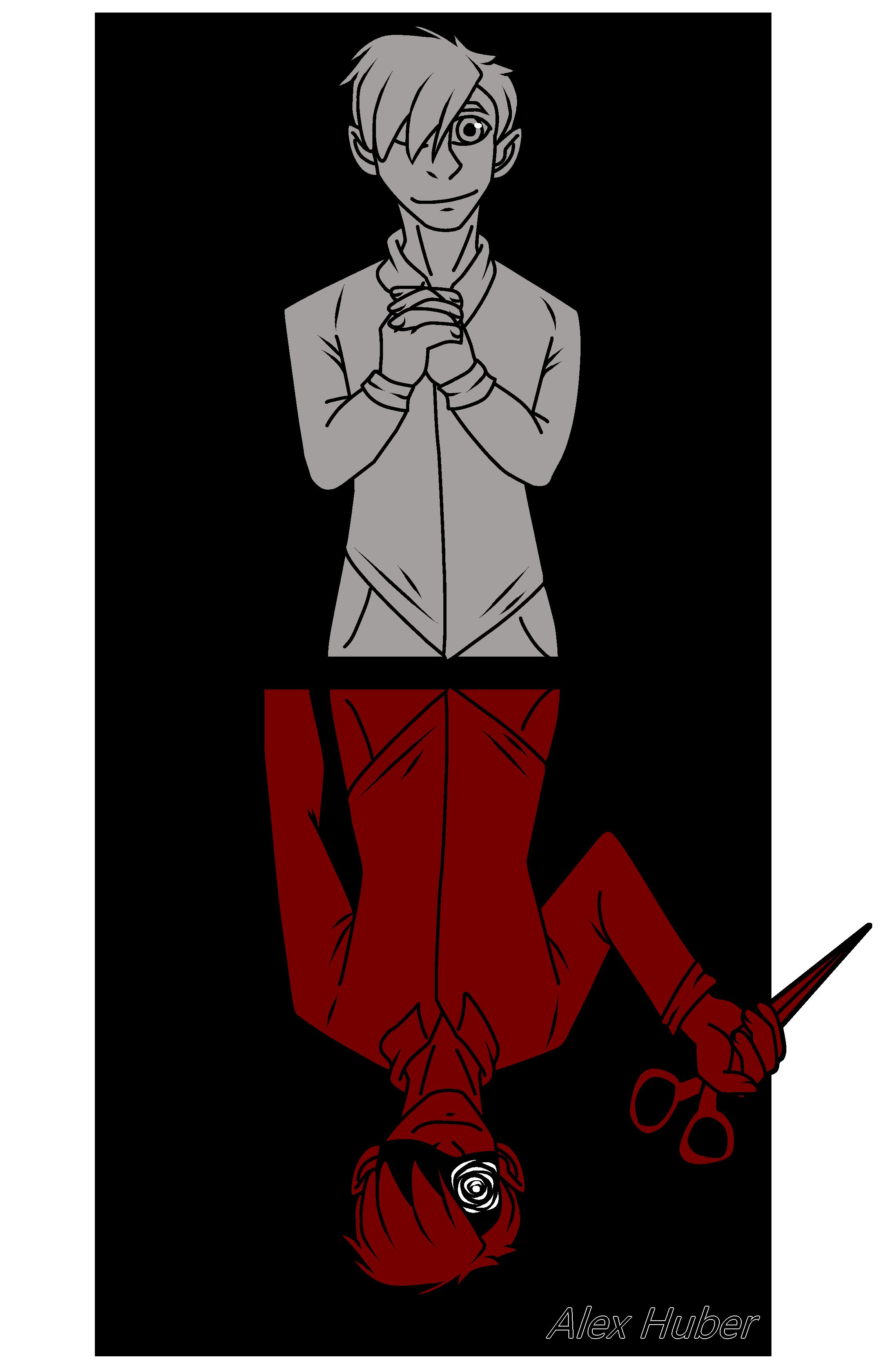
For my major project for this course, I wanted to tackle one of the texts we read this semester, Harper Lee’s To Kill a Mockingbird, and one of its most iconic disability-aligned characters, Arthur “Boo” Radley. Throughout the novel, Arthur is portrayed as a phantom hanging over the town of Maycomb, to the point where Scout, Jem, and Dill see him as an inhuman bogeyman. This is further punctuated by the nickname he is referred to as throughout the story: Boo. However, at the end of the story, Arthur is revealed to be a normal person, just like anybody else, and his implied disability (as the nature of his disability is never explicitly named or revealed) does not change that. As part of this project, I wanted to include both depictions of Arthur and show how they mirror each other, as although he is not a monster or bogeyman the rumors and stories are a part of how the people of Maycomb perceive him, especially the children.

At the start of the novel, Scout, Jem, and Dill have never seen Arthur, and as such they can only imagine what he looks like. In the first chapter, Jem describes him as being “about six-and-a-half feet tall,” “[dining] on raw squirrels and any cats he [can] catch,” having “blood-stained” hands, with “a long jagged scar that ran across his face,” and teeth that “were yellow and rotten” (Lee 14).. While I kept this description in mind as much as I could, ultimately I decided for a more abstract approach with the two depictions of Arthur. The Arthur at the bottom of the image is the bogeyman Boo Radley, colored entirely red with the blood staining his body from the animals he supposedly eats and holding the pair of scissors he is said to have stabbed his father with. His eyes are hidden by shadow, aside from the light shining from the one eye not covered by his hair, further pushing the imagery of Boo being a monstrous figure haunting the minds of those in Maycomb.

In contrast, the Arthur at the top of the image represents the Arthur described in the final chapter of the book, when Scout properly sees him for the first time after he saves her and Jem from Bob Ewell. In this description, Scout notes how his “face [is] as white as his hands, but for a shadow on his jutting chin,” how “his cheeks [are] thin to hollowness,” and how “his gray eyes [are] so colorless [she] [thinks] he [is] blind” (Lee 310). Once again, while I kept this description in mind as much as possible with my piece, I took an abstract approach and instead colored the entire Arthur a pale grey, depicting him smiling gently at the viewer with clasped hands. This depiction of Arthur, the true Arthur, is far more gentle than legends would have one believe, and while he does ultimately kill Bob Ewell, he only does so to protect the children he considered his friends.

Arthur Radley is far from the only example of a disability-aligned character in literature with a dramatically different reality from his reputation, but he is perhaps one of the most iconic, and certainly he is one of the most memorable characters from Lee’s novel.

Citations:

Lee, Harper. To Kill a Mockingbird. HarperCollins, 1960.

I hereby declare upon my word of honor that I have neither given nor received unauthorized help on this work. Alex Huber.

Major Paper/Project

“That scorching sun, ” Ismail exclaims. “All it does is wait to hit my eyes and blind me whenever I wake up.” “Maybe you should try to move out of its way ghabiun,” said Aisha. Ismail was furious with his sister usually. She was charged as his caretaker of the family but Ismail felt as though he never needed it. Ismail washes the majority of the dishes anyways and even sweeps the entire floor including the outside so Aviv the landlord leaves his family alone. More so than his sister, Ismail absolutely despised Aviv. Ismail had been in a wheelchair for about three years now, losing his ability to walk around age 11 because of Aviv. 

One day Aviv drove home in a bright maroon scooter with a single, powerful headlight under the influence of who knows what. Ismail happened to be playing football with a couple of former friends from the complex they resided in. The complex was surrounded by identical buildings, all to keep Ismail’s people separate from the all-powerful state of Israel. Across from the complex on the other side of the dusty, wasteland-Esque road was a market that Ismail could’ve swore spread from the water to the border. Ismail finished playing football and had decided to go purchase meat for his family’s dinner tonight as he was instructed by his father, Iyad. As Ismail approached the market it was too late. Aviv had already been focused on commotion outside of his complex, forgetting to look for those crossing the street and come into contact with Ismail’s tailbone. Local authorities had rushed Ismail to a local clinic where they informed him of his paralysis. Aviv paid no consequences due to his Israeli citizenship and if the Israeli government got word of one of their people in jail the consequences would be dire for Ismail and his family. Ismail did not mind his challenge however for he believed that God must have done this for a reason. 

“Just go to school already, you’re not my caretaker anymore,” said Ismail. “But Mom and Dad said-” said Aisha. “I know what they said but just let me do this on my own for once,” said softly to his sister. “I am not just a kid anymore, I really am just like everyone else now.” Aisha smiled at her brother admiring his will for he had always possessed more willpower than his entire family since his childhood. “Okay, but you have to promise me you will take the road around the protest mom and dad are going to today,” Aisha said carefully. Ismail was already out the apartment door. The apartment hallway was caked in filth and cigarette ash-covered each line that ran through the steel-colored concrete floor. Ismail recoiled to the smell of the complex every time he exited. He despised it. He wanted nothing but the best for his family and every day Ismail daydreamed of his success in the future. Ismail loved to daydream. As he made it out of the complex he began to add to his daydream portfolio. This time Ismail dreamt of him and his father visiting the aquariums he reads about in books from the local market stand about a block or two from the complex. As his wheelchair hit the dirt the dream began. The curtains in Ismail’s mind open to images of his father standing with him in front of a giant glass exhibit filled to the brim with every type of garish-colored fish he could think of. To the left he saw a school of clownfish, hugging to an amber-colored rock with algae surrounding the circumference of the rock. To the right, he saw three dolphins, one infant dolphin being cared for by the other two almost as if they had just picked the infant from school that day much like a human. 

“What are you doing boy?” the strange voice said in the dream. Ismail snaps out of his fantasy back to the wasteland street he had been on. “What?” Ismail said. Ismail looked right to see a tall, broad sand-covered man that had glasses almost too big to fit his face. The man had just finished his cigarette and had flicked the butt in front of Ismail’s chair. “That way is the protest. You know it’s not safe for you to continue this way,” the strange man exclaimed. As the strange man stepped into the scorching sunlight Ismail noticed that he was wearing a button-up with a Star of David necklace draped over his collar bone. The man was older yet he seemed sophisticated in a way that Ismail wasn’t used to. In that instant, Ismail had begun an epiphany. He had always wanted change for his family and now seemed as though a perfect opportunity to contribute to that. Ismail had decided to venture to the protest as he could already feel the shaking in the ground from several hundred voices. “I know sir, I was going to cut to the right ahead towards my school.” The man glanced at Ismail from head to toe, almost studying his entire figure as if Ismail was something he had never seen before. “Just don’t go to that protest boy,” the strange man said as he disappeared back into the shadows of Gaza. Ismail nodded and continued on his path towards the protest, simultaneously turning around to check for the old intellectual he had encountered minutes ago.

The Protest   

As Ismail conquered the last hill in his sight he began to see the protest in view. In his mind Ismail thought the protest would be several hundred people, waving signs of freedom, chants that would rattle the buildings around, but he was wrong entirely. The City of Gaza houses over 500,000 people and if Ismail had to guess at least 10,000 of them had shown up. The crowd almost moved as one organism, shifting against the Israeli Defense Force at once with a synchronized chant. As Ismail descended the hill his only thoughts were with his mother and father. They had told him the protest was only going to be a small one, nothing like what Ismail was witnessing. Ismail kept advancing with strife, nearly reaching the crowd as they sang songs of independence. Suddenly, Ismail heard about 6 or 7 loud popping sounds and instinctively put his head down. The popping was loud and carried sound waves throughout the barren streets, bouncing off each building as the sound reached them. Ismail needed a bird’s eye view to figure out what these sounds were. As Ismail was descending the street he proceeded to look left and right to find a view of the protest. To his left was only apartment complexes much like the one he lived in, except as these buildings approached the border they began to look sorrowful as Ismail glanced at each building. As Ismail glanced to the left he saw what seemed to be a department store of sorts that had been recently boarded up to either curb any conflict or they had just closed for good. Yet at the base of the building was a fence circling it with a cliff extending from the left side of the building overlooking the protest. Ismail followed the fence until he found a hold that fit him perfectly. 

More popping noises. 

Ismail couldn’t believe what he was witnessing as he approached the cliff. As he glanced over the army of protestors, he saw a massive force of Israeli soldiers with shields holding the crowd back. Behind and above the soldiers were about 10 or 15 other soldiers with Assault Rifles. Ismail knew what was going on. The soldiers had fired on the crowd as Ismail could see a small opening in the front of the crowd with an older man holding a young woman’s head up as she laid on the ground. The woman was lifeless with several other injured individuals in the gap of the crowd. They had all taken gunshot wounds mainly from the waist down leaving the individuals with no way to move back out of the crowd. Ismail was horrified by the actions of Israel. He knew that there was a conflict between Palestine and Israel but never to this degree. A hate started to brew in Ismail’s body and the only thing he could do at that moment was cry. It was not a cry for help but a cry of frustration. How hard was it to not shoot someone? How hard is it to just let our country keep its independence? Ismail let out a scream of frustration as he was still looking out to the gap in the crowd. 

“I watch this every day. I do nothing but think and watch. I watch a sickly amount of oppression every day from this cliff and I cannot help but feel anger.” It was the older man again. This time he was wearing a tank top that was originally white but covered in a dusty film that only made the man look older as a result. “Do you understand why I told you not to come now? It wasn’t because I wanted to keep you completely safe. I just felt as though the last thing you needed was more anger in your life. More anger to spread to others as my people have done to yours,” the old man said softly among the noise. Ismail understood his reasoning. “You could’ve just told me what was happening!” Ismail said, yelling to beat the noise of the crowd.

 “What is your name, boy?” the old man said. “Ismail, sir.” Ismail quietly mumbled. “Nice to meet you, Ismail. My name is Shiloh. I live across the street here in the complex.” the old man said. A silence had fallen between the two individuals. The only thing Ismail could do at that moment was just watch the crowd being pushed back, beaten, and experience the effects of tear gas tossed from behind the shield barricade. 

“Come with me Ismail for I want to show you something that may interest you. This is no place for a boy and your parents would never forgive me if I let you stay out here.” Ismail was a stubborn individual but even he knew this was not a place for him. Ismail glanced at the crowd one last time before entering Shiloh’s complex. An ambulance had flown down the road as the two entered Shiloh’s room. 

Shiloh’s room was completely organized from top to bottom. Every surface, counter, and floor in the house was spotless almost as if Shiloh had not been here in weeks. “I have been traveling so nobody has been in this room for a while.” As Shiloh went to take a seat he began to move his arm sideways and popped his arm clean off. Ismail noticed the plastic/composite frame more so in the poorly lit room than out in the sun. Shiloh had a prosthetic arm for his left arm. 

“This is what I wanted to show you. This happened to me about 4 years ago when the protests first began. A bombing took place during the protest I was at. We are all the same. Even if you and I live in such a way it does not define us. My job is going around the world and convincing people to think like this.” Ismail was in awe at this point. Ismail’s first impression of the old man was that he was just some old mildew-covered old man. However, looks are always deceiving and Ismail understood that now. 

Word Count: 1938

Write Up: 

Prior to writing this story about the Israel and Palestine conflict, I did heavy research in order to recreate the world that Ismail lives in. However, it is important to note the way I feel about this conflict as I have been following the news about Israel and Palestine since I was about fifteen years old. Nothing saddens my conscience more than hearing about innocent people being bombed, killed, and maimed in order to maintain “control”. I could never understand the trauma these individuals went through. However, I feel as though my voice may have an impact in fighting this conflict if expressed correctly. 

Puar’s piece, Right to Maim, was my main inspiration for writing this story as well as several podcasts I have listened to. Ismail’s role in the story was to give an extrinsic view of the conflict further showing how Puar’s concept of debility, capacity, and disability all intertwine. Ismail’s form of mental debility (even debility in the form of Palestinian strife) through his anger throughout the story and the lack of mention of Ismail’s wheelchair was to show how capacity is furthermore an issue in countries that lack the capacity to support these individuals. My reasoning for providing the outside view of the conflict from Ismail’s point of view was to provide a metaphorical view of looking from the outside of a conflict. As one may look from the outside of this conflict and see the biopolitical population control that Israel has implemented. With the inclusion of the scene where Ismail notices the gunshot wounds are only from the waist down as Israel feels that since there is no death there will be no consequence. My goal was to connect the flaws of this conflict and the ableist reasoning for why such issues occur. The Israeli government shows the use of this by maiming Palestinian citizens as their reasoning is rooted deep in capitalistic power and control of disabled or debilitated individuals.  The Palestinian population itself is debilitated in their protests for freedom as the able-bodied monopoly continues to keep these people under control. 

As Puar defines maiming as, “Maiming is a source of value extraction from populations that would otherwise be disposable.” Shiloh’s role in this story directly reflects this process of able-bodied governments maiming those who they feel as disposable as he went through this experience of maiming. Able-bodied governments like these will excuse such actions by, as Puar describes, calling these injuries, “expected impairments.” 

Metaphors throughout this text include the lack of life described in many of the buildings and the poor living conditions that these people live in. This directly attributes to the capitalistic, able-bodied control that Israel holds over the Palestinian population by forcing such individuals into these poverty-driven situations. 

I would like to reiterate that through works of literature such as this story and theoretical pieces that activists such as Puar provide will further the knowledge, solution, and advancement of disabled body rights that will provide a hopeful future ahead for not only the disabled community but those who reside in the ongoing conflict between Israel and Palestine.

Word Count: 515

Works Cited

Farzan, Antonia Noori, et al. “How Conflict, Blockades and History Have Shaped the Geography of Gaza.” The Washington Post, WP Company, 14 May 2021, https://www.washingtonpost.com/world/2021/05/14/gaza-strip-history-geography/. 

“Gaza Border Protests: 190 Killed and 28,000 Injured in a Year of Bloodshed.” The Guardian, Guardian News and Media, https://www.theguardian.com/world/ng-interactive/2019/mar/29/a-year-of-bloodshed-at-gaza-border-protests. 

“Gaza’s ‘Great March of Return,” Six Months On.” Amnesty International, 15 June 2021, https://www.amnesty.org/en/latest/campaigns/2018/10/gaza-great-march-of-return/. 

Puar, Jasbir K. The Right to Maim: Debility, Capacity, Disability. , 2017. Print.

Rachel Grace Chaos’ Major Project

“Once people understood the boundaries and nature of his madness they could fit him, so to speak, into the scheme of things”
“Golden”

The two paintings in this project are reflections of characters in Toni Morrison’s Sula. For the paintings, the mediums are collage and acrylic paint on canvas. The original goal in creating these paintings was an aim to reveal the implicit biases in each variation of a human and relate to our discussion of Sula that focused on how Morrison represents various disabilities. In the end, it became much more nuanced than that. The final works do, I hope, reveal the perspectives of disability that Morrison shows in Sula, but they also reveal the celebration of disability that Morrison creates in her text. 

First, a disclaimer: Morrison creates the characters in her novel to have complex identities that include race, gender, and physical, mental, and emotional disabilities. My pieces focus on textual descriptions and circumstances surrounding disability, I am not in any way trying to speak about Black individuals’ identities and their experiences, I am just continuously inspired by Toni Morrison and her work and created these pieces in response to her text.  

The physical process of creating these pieces centered around finding the appropriate clippings from magazines that I felt illustrated each idea best. In looking through the catalogs and catalogs and catalogs of magazines in my collection, the vision of the paintings comes together. The paint plays a big part in creating these pieces because color holds a lot of meaning to individuals. The left side of Sula’s piece could not just be a plain grey because her view of life still has depth. Can one properly convey madness without paying close attention to how they use the paints at their disposal? Once I finished combing through Morrison’s text, clipped the magazines, and mixed the paint, it was time to assemble the masterpieces. 

The first piece of work is an illustration of Morrison’s perspective of madness as illustrated through the character of Shadrack. The title of the piece is the quote that inspires it: “Once the people understood the boundaries and nature of his madness they could fit him, so to speak, into the scheme of things” (Morrison 15). Shadrack’s madness becomes the “fabric of life up in the Bottom of Medallion” (Morrison 16) and essentially, he fades into the background of the town, therefore the grey landscaping, grey clouds, and grey painted background show how the world exists with Shadrack; people simply “had no attitudes or feelings about Shadrack’s annual solitary parade” (Morrison 15). Morrison describes Shadrack and his “madness” on the “first… National Suicide Day” with “eyes [that] were so wild, his hair so long and matted, his voice so full of authority and thunder” (Morrison 15). Shadrack wears striped pants in the painting to represent his madness and has a small breaking bomb at the bottom of his feet as a metaphor for his “thunder” cracking the foundation of the town. 

Shadrack has an ability that no one else has in the novel, he empathizes with Sula. His ability to connect and reassure Sula, an almost untouchable entity, makes him one of the sanest characters in the novel, although the town sees him as “wild”. The yellow growing out above and beyond Shadrack shows the light that Shadrack brings to Sula in providing permanence in her life with his word “always”. The spirals spanning outside of Shadrack’s yellow identity are a metaphor for his National Suicide Day. Morrison introduces the act of National Suicide Day as an act of madness, but in the end, it is Suicide Day that recognizes suffering as human because “the same folks who had sense enough to avoid Shadrack’s call were the ones who insisted on drinking themselves to death or womanizing themselves to death” (Morrison 16). Shadrack, a madness-aligned character exists as a disabled identity in the town because of his mental disabilities from the war, but also in celebrating the same day every year, he provides sanity to the people who otherwise would not receive it. 

The second painting displays on the left how Sula sees the world and, on the right, how the world sees Sula. This painting is titled “Golden”. Sula exists, both through her birthmark and through her actions, as a spectacle and a body that violates the norm. Sula is a disability-aligned character because of the way others view her, she exists as “the devil in their midst” (Morrison 117). The right side of the painting reveals the spectacle and disgrace others see in Sula through the image of red representing the image of the “devil”. On this side, Sula wears a red dress, exists in a red cloud, and thinks in red thought bubbles because she is “the fourth” face of the “God of three faces they sang about” (Morrison 118). The fire, a symbol of something that continues to grow and devour surroundings, serves as a metaphor of the “birthmark that spread from the middle of the lid toward the eyebrow” which “grew darker as the years passed” (Morrison 53). This side also features a bird to represent “the plague of Robbins” (Morrison 112) with Sula’s return and a thought bubble with the image of a person jumping out of a window to represent the trauma of Hannah’s death that Sula carries with her. 

The left side of the painting represents how Sula sees the world and is based on the description of Sula’s eyes at the beginning of the novel, she has “gold-flecked eyes, which, to the end, were as steady and clean as rain” (Morrison 53). Sula remarks that “the real hell of Hell is that it is forever” (Morrison 117), which shows how dull she feels forever is. Consistency is Hell and “ugliness [is] boring” (Morrison 122) and Sula’s “lonely is [hers]” (Morrison 143), so I painted the background of her perspective grey with white flecks throughout. Sula’s overall perspective on life is that it is dull and boring, which so contrasts with how the town sees her. So, the two perspectives now live in conversation together on this painting revealing how Morrison writes Sula as a disability-aligned character and uses her to illustrate implicit biases. 

On the topic of implicit biases and devaluation of disabled bodies in disability studies is Snyder and Mitchell’s Introduction to Cultural Locations of Disability. Snyder and Mitchell discuss that “the devaluation of disabled bodies places in jeopardy all bodies that exist within proximity to ‘deviance’” (Snyder and Mitchell 5). This relates to my illustration of Sula because she exists less as a disabled body and more so as a deviant body in Morrison’s text and it is her “deviance” that marks her identity in the town, as illustrated on the right side of “Golden”. More so, Snyder and Mitchell discuss the cultural model of disability and come to an “understanding that impairment is both human variation encountering environmental obstacles and socially mediated difference that lends group identity” (Mitchell and Snyder 10). The idea of impairment as something that is socially mediated is relevant to my discussion earlier of Shadrack’s othering at the hands of the town. Shadrack exists as an othered body because “Once the people understood the boundaries and nature of his madness they could fit him, so to speak, into the scheme of things” (Morrison 15). Shadrack’s disability is, in part, a result of social mediation and how they designated him in society, which is visible in my portrait of him. The paintings reveal the idea of implicit biases of disabled bodies and Mitchell and Snyder’s discussion of “deviance” and how society deems what is acceptable and in what category it is. 

1252 words

I pledge- Rachel Grace Chaos

Works Cited

Morrison, Toni. Sula. Vintage Classics, 2020. Print.

Snyder, Sharon L., and David T. Mitchell. Cultural Locations of Disability. The University of Chicago Press, 2015. Print.

Major Project – Melissa Madsen, Kelly Brown, Lisa Gisselquist, and Rebecca Visger – The Impact of Therapy

While the four members of this group project all enjoyed reading The Secret Garden by Frances Hodgson Burnett, we argue that there was more potential for this book with regards to its disability themes. The Secret Garden focuses primarily on physical disability, with three of its main characters – Mary, Colin, and Mister Craven – being disability aligned, or in the case of Mister Craven, explicitly disabled. These representations become problematic, however, as the book becomes a cure narrative for Colin, and to a lesser extent, Mary. The Secret Garden also begins to engage with mental health as well. Chapter XXVII “In the Garden” opens with the narrator discussing human discovery, and how “In the last century more amazing things were found out than in any century before” (Burnett). Assuming the setting of the book is contemporary with its publishing date of 1911, the narrator is referring to the discoveries of the 19th century. One of these discoveries is that “thoughts—just mere thoughts—are as powerful as electric batteries—as good for one as sunlight is, or as bad for one as poison” (Burnett). The book does not delve much further than this binary of “good and bad thoughts” and that good thoughts make a “healthy mind.” Burnett was limited by writing in the dawn of the mental health studies, which had only really begun in earnest just three years earlier in 1908 (Mandell). With the benefit of over 100 years’ more research into the mental health field at our disposal, we wish with this project to expand upon themes of mental health already present in The Secret Garden. Through a triad of short creative stories, we examine how the depictions of the mental states of the characters Mary, Colin, and Mister Craven, if written in the modern era in a modern setting, would differ from their original depictions.

Our creative writings are in the format of therapist’s forms and notes describing the interactions and “professional” assessments of two mental health professionals concerning the characters of Mary, Colin, and Mister Craven. This format not only reflects a more experimental approach to form more common in the 21st century than the early 20th, but also how in the 21st century mental health is a specialized field of study and practice, carried out by licensed professionals rather than a general doctor or going wholly unacknowledged. Research for these pieces was carried out on an individual basis by each author, with advice on starting points provided by Melissa’s father, CDR Clifford M. Madsen. Research mainly consisted of investigating potential diagnoses of these characters and how they may be accurately and sensitively represented and written. Melissa’s piece focuses on Mary, addressing the trauma Mary would have felt and experienced after losing both her parents and the servants who raised her to cholera that goes unacknowledged in the book. It also explores the implications to Mary’s character if she had had an adult who understood and supported her as soon as she had arrived at the manor. Kelly’s scenario focuses on the implied mental difficulties Colin experiences that, in the original novel, like his physical condition, are miraculously cured by the garden. Lisa’s work contemplates how a therapist might have reacted to Archibald if he had been able to seek out professional help rather than isolating himself after his wife’s death. (Rebecca is the author of this write-up.)

The goal of this project was not to disparage Burnett’s approach to mental health in The Secret Garden; her inclusion of mental health at all proves she kept up to date with the findings of her time. She was writing from the metaphorical cutting edge, and we wanted to revisit her characters and vision from our new edge. These creative writings reveal not only how far the field of mental health has come since 1911 through acknowledging the toll these characters’ collective life experiences would have taken on their psyches, but also that they would have benefited from more tangible help than the moor air or the secret garden could supply. In writing all that was known about at the time, Burnett revealed how much was left to be explored, and no doubt our work in the future would be viewed similarly. The format of our works and writing from therapist’s perspectives is indicative of, for better and for worse, the heavy emphasis on medicalization mental health receives in our time. Burnett’s work was progressive for her time, and maybe ours is too, but progress will keep going, and our writing will remain right where it is.

~^*^~

From the Office of Dr. Janice Gardner

Patient: Mary Lennox
Age: 10
Treated For: Childhood Trauma
Office: At-Home Visits
Alternate Address: Misselthwaite Manor, The Moor, England

Entry 1
I received a call from Mrs. Medlock last night. I was surprised that her focus was not on my usual patient, but on a girl who moved into the manor a few weeks ago. Apparently, Craven’s brother adopted his niece, Miss Mary Lennox, after an undisclosed event related to her previous home. While Mary’s physical condition had slightly improved since she arrived at the manor, she has developed a disagreeable disposition and a habit of acting out of line, which prompted her maid, Miss Martha Sowerby, to ask the housemistress to call me. Because of the girl’s history, Martha was afraid that the situation would deteriorate without my intervention, so Mrs. Medlock urged me to come to the manor for an introductory visit as soon as possible. I have learned to always trust the intuition of a Sowerby, so I accepted the invitation.

I arrived at the manor this morning to find a stubborn Miss Lennox sitting at the window with her arms crossed. The girl looked thin for her age, and glared at me when I walked into the room. We exchanged stilted introductions, then Mary promptly informed me that she does not want a governess. I promptly informed her that I am not a governess, but a therapist who was called to help her. Mary started to yell at both Martha and I about how she wasn’t crazy and that she didn’t need a therapist! She didn’t need help! She didn’t need anyone!

It took about ten minutes for Martha and I to calm her down. Once the dust settled, I asked Mary why she said she wasn’t crazy. She looked to Martha, who gave her an encouraging nod. Mary proceeded to tell me about what happened: how she heard someone crying in the night, how it became louder in the corridor, how Mrs. Medlock stopped her from going any further…

“I tried to ask Mrs. Medlock what was going on. I tried to tell her about the crying, but she said it wasn’t real. But there was someone crying – there was – there was!”

When I told her I believed her, Mary stared at me in shock; she hadn’t expected that answer. I proceeded to tell her who I am and what I do for a living – help people heal from or deal with mental wounds, trauma, and disorders. I reassured Mary that she can tell me as much or as little as she wants; I am only here to figure out if there is something deeper going on and help her as much as I can if that is the case. However, I made it clear that I would not pry or continue if Mary did not want my help. She looked over to Martha again, who gave her another encouraging nod. She accepted, and we agreed that I would come back to the manor in two days’ time for a proper appointment.

Judging by the minimal information I received from Mrs. Medlock and my meeting with Mary earlier today, Mary may be dealing with unresolved childhood trauma. She’s showing many of the indicators in her demanding and possessive behavior, the way she carries herself, and how she interacts with others. I will not know for certain until I talk with her at our first appointment, however, if this is the case, I may have a technique that can help her.

Entry 2
I came into Mary’s room today to find her waiting for me next to the fireplace. She still seemed hesitant, but more comfortable than before in speaking with me, so we wasted no time and immediately got to work. I started the session by asking her various questions about her life. What is her life like at the manor? Does she have any friends? What is her relationship like with Mr. Craven and the other servants?

Mary hesitated at first, but once we started talking about Martha and the gardens, her eyes lit up and her entire demeanor changed. She started talking about the manor as a positive experience so far and how her favorite activity is walking around the gardens and enjoying the moor air, something that she was not able to do back in India.

Using that answer as a segway, with her permission, I then moved on to asking questions about her past. What is her relationship with her parents? Did she previously live in India? How did she like living there? And what happened in her previous home that caused her to come to the manor?

The answer is not a pretty one. Mary used to live on her parents’ estate in India. As soon as Mary was born, Mary’s mother entrusted her care to an Ayah, an Indian nanny, who kept Mary out of her parents’ sight as much as possible and catered to her every need. However, a few months ago, most of her family’s household fell victim to an Indian strain of cholera, including her parents, her Ayah, and most of the servants. The few who survived forgot about Mary and left her alone in the estate. She was found days later by a group of officers. While she spoke of her experiences, Mary’s face shifted from impartial to fondness to discomfort to something unreadable. The rest of her body became more and more tense as her story went on. Despite her independence, her experiences have affected her more than she’s willing to admit.

Not wanting to get too deep into processing yet, I guided Mary to start talking about our plan of action. I introduced her to EMDR and how the technique allows her brain and body to process trauma by giving her eyes two moving dots to focus on while she reflects on her experience. We discussed at length what memories Mary wanted to target and in which order, and agreed that we would start with her early childhood next session.

In the meantime, I guided Mary in establishing her safe place so that she had a tool to use in between sessions to handle any annoyance or surfacing trauma brought on by the processing. I asked her to think of a place where she feels safe and, if she felt comfortable, to describe it to me. She chose a peaceful, quiet, secluded garden with tall walls made of ivy and many different flowers growing around the area, all connected via a cobblestone pathway. The rose bushes grow the tallest, almost rivaling the ancient trees that provide shelter to birds native to the moor, most prominently red-breasted robins. A wooden door is the only way in or out, and is hidden from the outside world by a wall of ivy that covers the doorway, making it blend in with the rest of the wall. Mary keeps the only key to the door on her person, allowing her to come and go whenever she pleases and unlock the door whenever she likes.

“…I can unlock the door whenever I like…”

Mary paused after that last sentence, as if she was pondering something. She put her hand in her pocket. I could see the realization slowly dawn on her face as the seconds passed. I asked her if she was alright, but she only replied with a simple yes. I decided to not push her any further, not wanting her to lose the progress she’d made so far. I asked her to think of a word that best describes this place in her mind, a word that would trigger her recollection of this place and how good she felt in this moment. Her response: garden.

Entry 3
This house continues to surprise me.

Mary has made excellent progress on processing her trauma. She has successfully processed much of her early childhood; the only events left are her abandonment following the cholera outbreak and her journey to the manor. It has not been an easy road, however. Mary has grown comfortable enough to let me see her most vulnerable side. In our last session alone, she expressed how she felt betrayed by the servants who left her, how she felt angry at her parents for not spending time with her, how she felt so alone in the hut after everyone had left with only a snake to keep her company. Some sessions have ended with warm feelings and closure; others have ended in tears and fluffy blankets. I was informed that this same effect has spread into the rest of Mary’s life; some days she feels joyful while others she just wants to curl up on her bed and cry. Mary has been utilizing her calm place in those moments to help her, and I can see the positive effects of our treatment finally shining through.

Mary and Martha have become close friends over the past few weeks. Mary has become comfortable with Martha helping her through her troubles; sometimes she specifically calls for Martha to be in the room during our session so she can provide moral support. I am also told that Mary has made friends with one of the gardeners and Martha’s brother, Dickon. This is wonderful news; Mary finally has a stable social circle!

At the same time, Mary’s physique has also greatly improved since I first met her. She spends every day she can out in the gardens, building her strength and developing a healthy appetite. She now has so much energy that her positive attitude almost becomes infectious. In our last session, she proudly informed me that she can now do one hundred skips and is aiming for two hundred.

Mary’s vast improvement is wonderful, of course, but it makes me wonder – what exactly is happening in that garden? If there is some sort of secret trick to all of this, Mary is certainly benefitting from these positive effects. And if Mary has shown this much improvement in so little time, is it possible for her to inspire another to do the same?

…I should introduce her to Colin.

~^*^~

From the Office of Dr. Janice Gardner

Patient Name: Colin Craven
Age: 10
Treated For: Conversion Disorder
Office: At-Home Visits
Alt. Address: Misselthwaite Manor, The Moor, England

Entry 1
Progress with the patient has been, regrettably, extremely lackluster. Colin is a bright young boy, but he refuses to even consider what he is capable of because of his mental disability. It truly holds him back, in more ways than one. He claims he will not live to adulthood, and worse, that everyone would be happier if he died. Time and time again I have encouraged him to rethink his fatalistic mindset, but to no avail. Colin simply sees no reason to improve, and should this behavior go on, I will have to end our sessions indefinitely. It would absolutely break my heart, but Craven needs to understand that I can only do so much for an unwilling client.

When I compare Colin’s treatment, or lack thereof, to that of Miss Mary Lennox, I notice a striking amount of similarities between the two. Both have extensive trauma that originates from the hostile environment they were raised in, but unlike Colin, Mary has gradually learned how to open up about what she went through. Colin has not yet found a sense of trust in me, because in his eyes, I am just another adult he can give orders to. That is why I wholeheartedly believe Mary, a child his age, can help. Normally I would never ask patients to get involved in cases besides their own, but I will make an exception, seeing as Colin and Mary live under the same roof. I have no doubt that, if nothing else, they are at least acquainted with one another. I plan to ask Mary for her assistance during our next meeting, and if she takes interest, I will lead her to Colin’s room. From there I will decide whether or not to continue holding group sessions based on how responsive Colin is, but let it be known that this is my last resort. In terms of outcome, I expect the worst, but hope for the best.

Entry 2
Prior to today’s meeting, I have kept my assumptions on the Misselthwaite staff to a minimum. How they interact with Colin, and therefore Mary, is entirely their call, and I am in no position to criticize or reprimand them. Despite that, had I known they were withholding Colin’s very existence from Mary, I would have intervened sooner. No matter how unbearable he is, Colin still deserves respect from the servants. It is unfair, and frankly insulting, to not give him the decency of acknowledgement. Hence why, upon seeing Mary’s confused expression, I realized she’d never heard his name before. I knew what needed to be done from there.

When the two children made eye contact for the first time, they were speechless. Quite literally, in fact: for a good while they just gazed at one another, in complete and utter silence. Finally, Mrs. Medlock broke the tension, asking what I had brought Mary here for. I explained to her what I had planned, and although reluctant, she conceded and left the room. We began with introductions and small talk, and once those fell flat, I prompted Mary to tell Colin about her calm place. That piqued his curiosity, but when he asked if he could visit, his smile faded. “Never mind.” He uttered solemnly. In all my time knowing Colin, never before had he seemed so excited to do anything besides wallow in lament. It was as though listening to Mary helped him forget about his disability, if only briefly. Our session ended shortly after, but not before Colin asked Mary to come back later without me. I can only imagine he wants to hear more about the garden.

Overall, I would call this experiment a success, but that does not excuse the circumstances surrounding it. It is no wonder Colin feels like a burden when everyone in Misselthwaite treats him as such, and the next time I see Craven, I intend to give him a piece of my mind.

Entry 3
Approximately three weeks have passed since I implemented group sessions, and the patient is showing various signs of growth. For starters, we moved our meeting location from his bedroom to the main corridor, and he no longer needs Martha’s help walking between rooms. Colin also has grown closer with Mary, as supposedly he does not “summon” her like he does with the servants. I have reason to believe she is his first real friend, and that is something the grown-ups in his life could never be.

Colin’s bond with Mary seems to have affected his trust in me, for I am the one who brought the two together. He is now a lot more honest during our one-on-one visits, and just recently he began opening up about his late mother. Because it is a very serious topic, I have sworn to keep everything confidential, and Colin may stop at any point if he starts feeling uncomfortable or upset. From what he has told me so far, his mother died shortly after giving birth to him. His father, Craven’s brother, never truly recovered from it, and has been neglecting Colin ever since. “I look too much like her…” Colin said, and did not elaborate any further.

The fact that Colin now feels safe enough to confide in both myself and Mary is a step in the right direction, and at the rate we are currently, I expect he will continue improving.

Entry 4
This will be my last entry for the time being, but that is not necessarily bad. Just the opposite: Colin is finally understanding how much potential he has. Of course, none of this could’ve happened without Mary; she has comforted him beyond our group meetings, and even introduced him to Dickon. I am very grateful to her, as well as Martha, who eventually realized how crudely the servants of Misselthwaite were treating Colin. “What do you suggest we do when Colin is upset?” She privately asked me after a visit. My advice was to not get frustrated: “Give him space to breathe, help him feel better once he calms down, and let him vent out any lingering emotions rather than bottling them up.” She shared my advice with the rest of the household, and by the time I returned for my next session, the hostility of the environment seemed to have declined. As for Colin’s health, he is no longer a pale and sickly boy who hates being looked at. He has managed to step outside the manor at least once or twice, and I think spending time outdoors will do him some good, like it did with Mary. He will likely need more time to learn how to properly walk, but I have recommended a physical therapist for him to try in the meantime.
Colin and I will be meeting on a less frequent basis from this point onward, but I still intend to check up on him at least once a month. Recovery does not happen overnight; for some people it can take years to properly heal, as is the case with Colin’s father. Still, Colin has come a long way since we first met, and I could not be prouder.

…Speaking of Colin’s father, Craven told me his brother is seeing a therapist of his own.

~^*^~

Year: 2021
Patient: Archibald Craven
Treated for: Depression
Psychiatrist: Dr. Peggy Blackwood

April:
I met with Archibald Craven again today. Since his brother recommended him to me for treatment a year ago, we have not made much progress. He continues to struggle with depressive episodes, often leaving home for months on end to escape the reminders of his dead wife and his sick son. Any mention of his son or the garden is likely to trigger a new episode. He has been largely resistant to any attempts to relieve his depression.

During our session today, a strange event occurred. The appointment began as normal. He has been in one of the deepest depressive episodes I have ever seen him in for the last week. Dr. Craven contacted me, concerned for his brother’s safety, and we scheduled this emergency appointment. Archibald was very despondent and barely receptive to talking with me or to my suggestions.
With forward progress halted, I changed techniques and started him on a processing treatment called EMDR. It is typically used with PTSD patients to help them deal with their trauma, but I chose to try it with Archibald since normal methods and medications weren’t working. The goal of the exercise was to keep his eyes occupied with something visual on a screen while his mind had a chance to wander and process ­­the trauma of his wife’s death and the worry for his son’s survival in the ensuing months. I instructed him to pick a particular event to focus on.

At the beginning, he was resistant, as he is to most treatments. Then, he almost seemed to be drawn into the process, his eyes focusing on the two dots bouncing around on the screen as his mind wandered. I heard him mumble something about “a bubbling brook” as his face started to soften slightly. It wasn’t a smile, but it was as close to one as I had ever seen. His shoulders relaxed almost imperceptibly. As our session ended, I tried to ask him about the experience, but he just gave me a sad, half-smile and left the room.
I notified my assistant to schedule another appointment soon. Though Archibald was difficult to pin down with all his travels, I didn’t want this development to be in vain.

June:
Since the breakthrough two months ago, Archibald has continued to progress, with only small setbacks. He has begun attempting the various exercises I put before him. His mental health has started to improve at a slow pace but a still moving pace. He has even begun to contemplate returning home, which is unusual. The last time he returned home, it was only because his brother needed him for a few days and Archibald left as soon as he could. He also admitted that he has stopped seeing his wife as often in every window and face that he sees.

As our session started, I started him on EMDR again. This time, his face started out gentle. After a few minutes, his head started to tilt to one side as if he was listening to a faint voice.

Suddenly, he sprang to his feet.

“Lilias! Where are you?”

Naturally, I was concerned. Hearing voices is a step in the wrong direction. This was a setback rather than the improvement I had been hoping for. Then again, he had never mentioned his wife’s name. He stood there listening for several long moments before speaking again. I waited, not wanting to interrupt his trance-like state lest I injure him. He appeared as one sleepwalking.

“In the garden! But the door is locked and the key is buried deep.”

Perhaps this was a good event after all. He had never mentioned the garden before. I only knew about it from Dr. Craven. Archibald appeared to recover from his dreamlike state and looked around, startled to see where he was. He quickly picked up his briefcase and began searching through it. Pulling out a piece of paper, he read it before returning it to its previous resting place. He grabbed his coat and briefcase, told me farewell, and left.

I must remember to follow up with Dr. Craven shortly. Leaving Archibald alone in such a vulnerable state was unadvisable.

July:
I received the shock of my lifetime today. Since our last visit, I had not seen or heard from Archibald Craven. Dr. Craven had alerted me not to be concerned, but I was still apprehensive about Archibald’s mental state. I had reached out to him on multiple occasions but there was no response.

Today, he walked through the door, as tall as I have ever seen him stand with one arm wrapped around a girl and one around a boy. The boy looked too much like his father for me not to make the connection. However, the boy was healthy. I had been told that he was in imminent danger of death.

A smile burst from Archibald’s face as he shook my hand and thanked me for everything I had done. He flooded me with information about the miraculous recovery of his boy and the wonderful garden. He promised to return in the short future to check in. I watched in a daze as he left with his small family.

I would follow up with him shortly. This recovery was impressive, but I knew that only careful work over the next couple of months and years would ensure its permanence. I would also have to check out this magical garden. If it had cured all three of them, perhaps it could help others.

Works Cited

Burnett, Frances Hodgson. The Secret Garden. Project Gutenberg, 1994, https://www.gutenberg.org/files/113/113-h/113-h.htm, Accessed 16 Nov 2021.

CDR Clifford M. Madsen USN MC Sports Medicine Physician. Personal Interview. 4 Nov. 2021.

“Conversion Disorder: What Causes It and How Is It Treated?” WebMD, https://www.webmd.com/mental-health/what-is-conversion-disorder. Accessed 15 Nov. 2021.

Dr. Mandell. “Origins Of Mental Health | Johns Hopkins Bloomberg School Of Public Health” Johns Hopkins Bloomberg School Of Public Health, 1995, https://publichealth.jhu.edu/departments/mental-health/about/origins-of-mental-health.

Dr. Amira Niori. Personal Interview. 12 Nov. 2021.

What Is EMDR? – EMDR Institute – EYE MOVEMENT DESENSITIZATION AND REPROCESSING THERAPY. https://www.emdr.com/what-is-emdr/. Accessed 16 Nov. 2021.

Word Count: 4620

We hereby declare upon our word of honor that we have neither given nor received unauthorized help on this work.
-Melissa Madsen, Kelly Brown, Lisa Gisselquist, Rebecca Visger

Katy Rose Price’s Major Paper

Racialized Notions of Ability in Special Education

Race and disability are assumed to be fixed and relatively obvious but rather are categories that are socially constructed and constantly contested and redefined. Historically, both have operated to define, oppress, and segregate. In 1972, legislation was introduced to Congress regarding the education of children with disabilities and in 1975, Congress enacted Public Law 94-142, then called The Education for All Handicapped Children Act of 1975. The passage of this act, now known as the Individuals with Disabilities Education Act (IDEA), guaranteed students with disabilities a free and appropriate education in the least restrictive environment (Ferri and Connor 454). Despite this, many students with disabilities are placed in educational settings that distance them from their non-disabled peers. This is further confounded by the overrepresentation of minority students in special education, with Black students being overrepresented in nine of thirteen disability categories. Furthermore, Black students are more likely than their white peers to be placed in exceedingly restrictive and exclusionary education settings (Ferri and Connor 454). In education as a whole, but particularly the field of “special” education, which has frequently been recognized as a multifaceted and fraught area, race and class influences can significantly shape students’ experiences (Gillborn). Special education allows the larger educational system and broader society to function in the ways they do, in addition to upholding and reinforcing the social and cultural norms of said society. Special education has traditionally escaped critical scrutiny because it is understood to be synonymous with “benevolent humanitarianism” (Tomlinson, 2014: 16)—one that conceals and normalizes practices that impact different social groups in dissimilar ways. In this paper, I argue that, since the establishment of special education, the discourses of ableism and racism have become conflated with one another, thereby permitting forms of racial segregation under the façade of “disability.”

Until the implementation of IDEA in the mid-1970s, many students with disabilities were barred from any education based on the discretion of schools that could claim an inability to accommodate such students (Ferri and Connor 457). Prior to this, the first half of the 20th century saw the increasing number of separate facilities for children deemed as “slow” or “r*******,” with it being no coincidence that the U.S. eugenics movement was occurring simultaneously (Ferri and Connor 457). During the 1950s, there was a marked rise in standardized testing that operated to help institute a set of inflexible norms surrounding academic ability based largely on white, middle-class American understandings, expectations, and principles. This designated students as “normal” or “average,” while those who deviated from those labels were separated (Ferri and Connor, 457). Furthermore, the process of labeling students progressively increased during the 1960s with the advent of the term learning disability (LD), as well as the escalation of the usage of the term emotional disturbance (ED) in the field of education (Ferri and Connor 458). According to Christine Sleeter (2010), the category “learning disabilities” arose as a calculated move to shelter the children of white middle-class families from possible downward mobility through poor school achievement. In this way, this category can be seen as part of overt attempts to protect the scholastic privilege of white middle-class America who were unable to meet boosted academic expectancies of post-Sputnik era curriculum alteration. Additionally, this allowed families of white, middle-class children an alternate and less stigmatizing avenue to justify their children’s difficulties and to gain access to special services (Ferri and Connor 458).

Throughout history, the perception of disability continues to be elucidated as the “natural site of abnormality and fearsome difference—the ‘abject’” (Erevelles 83). Many scholars and theorists have traditionally thought of disability as a biological category, one that is founded in the “medical language of symptoms and diagnostic categories” (Linton 8). However, disability studies scholars have imagined disability as a socially constructed category, one that “derives meaning and social (in)significance from the historical, cultural, political, and economic structures that frame social life” (Erevelles 85). The social model of disability also considers that even the most marked so-called “impairments” only become disabling when encountered with socially constructed problems and postulations (Gillborn). As such, disability brings to light the intricacies and assumptions that are intertwined in our social hierarchy and social categories—thus, lending to the idea that disability “can be theorized as constitutive of most social differences, including race” (Erevelles 85). Implicit in the construction of disability is the compulsory able-bodiedness that asserts that what is both desirable and moral is essentially heteronormative and non-disabled (McRuer 2). As Erevelles argues, “In these contexts disability is required to be simultaneously hypervisible and yet invisible in the medicolegal measurement of social and moral worth, serving as the yardstick that resurrects social difference only to hasten its instantaneous disappearance” (82). Thusly, compulsory able-bodiedness is often employed to separate conventional society from those who are considered threatening outcasts (Erevelles, 89).

In conjunction with compulsory able-bodiedness, it is necessary to understand the implications of Foucault’s theory of bio-power. Bio-power is thought of as the “explosion of numerous and diverse techniques for achieving the subjugations of bodies and the control of populations” (Erevelles 84). One of these techniques is the use of the medical model of disability to vindicate the continued segregation and removal of disabled people to alternative schools, special education classrooms, and segregated residential institutions (Erevelles 84). This exemplifies how disabled people are constructed to be unworthy, undesirable, and needing to be removed from the gaze of society. The construction of inferiority and mental deficiency contains entrenched and entangled histories of ableism and racism that function to place Black and minority students in segregated special education classrooms, as they are perceived as dangers to the “normal” practices of schooling and to the general education population (Erevelles 92).

In order to fully comprehend the confluence of race and disability in special education, first one must consider the status of both race and disability as socially constructed concepts by a society that values and aggrandizes whiteness. As Erevelles argues, “both disability/impairment and race are neither merely biological nor wholly discursive but rather are historical materialist constructs imbricated within the exploitative conditions of transnational capitalism” (87). This elucidates the concept that race and disability should be understood principally as interactive social constructs, not distinct biological markers as they are often thought to be. The U.S. rhetoric of race and disability are intertwined and interdependent and are employed to validate both exclusion and marginalization (Ferri and Connor 455).

When looking at the U.S. educational system, perhaps the most infamous ruling is Brown v. Board of Education of Topeka (1954), determining that racial segregation in schools is unconstitutional. Brown paved the way for the passage of IDEA in 1975, establishing legal precedence and many of the same principles seen in IDEA. However, this ruling was implemented in a society “with a dominant ideology that racializes notions of ability and merit” (Ferri and Connor 455). As such, systems of power that rely on the maintenance of said dominant ideology shifted divisions of students based on racial “difference” to divisions according to “disability,” as it became more accepted. Disability has become a more socially accepted, perhaps even normalized, sort of marginalization of students of color. While IDEA requires that students be placed in the “least restrictive environment” (LRE), this can often not be the case. Though IDEA has been greatly successful in affording students with disabilities access to public and free education, many students, especially students of color, have been placed in more, rather than less, restrictive placements. As a result, some have called LRE a “loophole” that has aided in the establishment of two largely separate and unequal education systems—general education and special education (Ferri and Connor 456). There are disproportionate numbers of students of color, particularly Black and Latinx, who are identified as disabled and placed in highly segregated settings. For example, Black males are more than twice as likely as their white peers to be labeled mentally disabled in thirty-eight states, emotionally disturbed in twenty-nine states, and learning disabled in eight states (Parrish). When given these three labels, students of color are more likely to be removed from general education classrooms (Ferri and Connor 458). Parrish determined that white students generally are “only placed in more restrictive self-contained classes when they need intensive services. Students of color, however, may be more likely to be placed in the restrictive settings whether they require intensive services or not” (26). Furthermore, research suggests that the amount of time a disabled student is placed in their general education classroom is highly correlated to their race (Ferri and Connor 459). Above all, this exemplifies how intensely racialized notions of ability are engrained in our culture and society. They are so deeply entrenched that the segregation of disabled students has also meant segregating students of color. The label of “disabled” was and is employed to resegregate classrooms along class and race lines after the passage of Brown.

In the late 1980s and the early 1990s, advocates for disability rights began to lobby harder for more inclusive placements for all students with disabilities (Ferris and Connor 460). Their efforts resulted in the reauthorization of IDEA in 1997 to what it is today. They further argued that exclusionary schooling practices are indicative of larger societal patterns that continue to struggle against the increased inclusion of people with disabilities in schools and society (Ferris and Connor 460). The public reaction to inclusion for people and students with disabilities was somewhat similar to the reaction to school desegregation, as it was met with strong opposition. For instance, Albert Shanker, the former president of the American Federation of Teachers, declared that inclusion was “a recipe for educational disaster” (Ferris and Connor 460). As a result of pushback to inclusion in school and the widespread belief that implementing inclusion in schools across the country would be unwise, it was argued that a more gradual approach was required. This argument failed to take into account that twenty years had elapsed between the passage of IDEA and any serious attempts to facilitate full inclusion of students with disabilities (Ferris and Connor 466). The approach of gradualism, the same approach taken with racial integration in schools, has been shown, both with inclusion and integration, as possibly being more damaging in the long run, as they result in backlash, resegregation, and little to no real progress. The decision to proceed gradually with inclusion shows the lack of commitment to it and the little value placed on students with disabilities, as many school districts continue to exhibit apathy towards students with disabilities in general education classrooms (Ferri and Connor 467).

Special education, despite being created to meet the needs of diverse learners, has been used to produce and perpetuate the marginalization of individuals founded on the interrelated discourses of race and ability. Individuals who have been deemed undesirable as a function of their race or disability or confluence of both have been designated as the “abject,” as the “other.” These designations are maintained by the dominant groups or ideologies in our larger society which are at least white, able-bodied, heterosexual, and middle to upper class. The dominant group retains and establishes its power over disabled people and people of color (who are outside of the dominant group) by labeling them as unambiguously inferior. These perceptions are deeply entrenched in oppressive legislation, educational practices, and practically every system that has been built for and by the dominant group. Schools uphold and reinforce these dominant beliefs and, as such, are instances of racism and ableism in practice.

As is always the question: where can we go from here? Ferri and Connor conclude that “until the population becomes committed to sharing power on a more equal basis, true diversity within our democracy can only remain an ideal out of reach” (471). While this may be true, there are practices and strategies that can be implemented to help students already in the educational system and those that will enter before we have reached substantial change. Due to the conflation of disability with race and class indicators, some disability studies scholars question the practice of labeling students at all. They argue that it is not necessary to deliver remedial instructional services in segregated settings. In place of these harmful practices, they promote inclusive education that is grounded in constructivist and differentiated instruction, as well as universal design (Reid and Knight 21). In creating an educational system that values and respects each and every one of its students, we must commit to anti-racism, anti-oppression, and a better future for people with disabilities.

Works Cited

Blanchett, Wanda J. “Disproportionate Representation of African American Students in Special Education: Acknowledging the Role of White Privilege and Racism.” Educational Researcher, vol. 35, no. 6, 2006, pp. 24–28. Crossref, doi:10.3102/0013189×035006024.

Erevelles, Nirmala. “Crippin’ Jim Crow: Disability, Dis-Location, and the School-to-Prison Pipeline.” Disability Incarcerated: Imprisonment and Disability in the United States and Canada, edited by Liat Ben-Moshe et al., 2014th ed., Palgrave Macmillan, 2014, pp. 81–99.

Ferri, Beth A., and David J. Connor. “Tools of Exclusion: Race, Disability, and (Re)Segregation Education.” Teachers College Record, vo. 107, no. 3, 2005, pp. 453-74, doi:10.1111/j.1467-9620.2005.00483.x.

Gillborn, David. “Intersectionality, Critical Race Theory, and the Primacy of Racism.” Qualitative Inquiry, vol. 21, no. 3, 2015, pp. 277–87. Crossref, doi:10.1177/1077800414557827.

Linton, Simi. (1998). Claiming Disability. New York: New York University Press.

McRuer, Robert. 2006. Crip Theory: Cultural Signs of Queerness and Disability. New York: New York University Press.

Parrish, Thomas. (2002). “Racial Disparities in the Identification, Funding, and Provision of Special Education.” In D.J. Losen & G. Orfield (Eds.), Racial Inequality in Special Education (pp. 15-37). Cambridge, MA: Harvard Education Press.

Reid, D. Kim, and Michelle G. Knight. “Disability Justifies Exclusion of Minority Students: A Critical History Grounded in Disability Studies.” Educational Researcher, vol. 35, no. 6, 2006, pp. 18–23. Crossref, doi:10.3102/0013189×035006018.

Sleeter, Christine. “Why Is There Learning Disabilities? A Critical Analysis of the Birth of the Field in Its Social Context.” Disability Studies Quarterly, vol. 30, no. 2, 2010. Crossref, doi:10.18061/dsq.v30i2.1261.

 Tomlinson, Sally. The Politics of Race, Class and Special Education: The Selected Works of Sally Tomlinson (World Library of Educationalists). 1st ed., Routledge, 2014.

Word Count: 2088

On my word of honor, I have neither given nor received any unauthorized help on this assignment.

Terrencia Johnson, Miranda Colbert, and Megan Hofmann’s Major Project – Disabled vs. Able-Bodied Gameboard

(Word Count: 525)

For our major project we constructed an image that showcases the unfair advantages abled-bodied people have over a person with disabilities. There are two players in the board game. One being an able-bodied person and the other with disabilities. Although both players are starting the game off at the same place, the path to “win” is not the same. The curvy path a person with disabilities has been much different from the straight path an able-bodied person has. At first glance you can see that it is unfair and not equal. This is the reality for people with disabilities all over the world. On each game square there are different elements that describe issues the player must go through in life. For the disabled person, their squares are more difficult. For example, one square says, “Not every place is accessible.” This connects to Good Kings Bad Kings when Yessenia “Yessie” Lopez had to get help from Pedro for her to use the bathroom. To Pedro, his apartment was accessible to him, but for someone in a wheelchair it was not accessible.  Another square says, “People obsess over the disability rather than the heart.” This connects to the Weise poem when the speaker was going to have intercourse with someone else, but the other person was more interested in the prosthetic leg. This ruined the speaker’s mood and made her rather be anywhere else than in this room with this person who is obsessing over her leg. In addition, another square has the single word, “inferior” displayed in it. This label can be interpreted in multiple ways, however, in this specific case the board game relates the label back to the concept that people with disabilities are often viewed as inferior, resulting in non-disabled individuals praising small, everyday tasks completed by the individual who has the disability. This exact concept is clearly portrayed in John Lee Clark’s poem, Deaf Blind: Three Squared Cinquain. In Lee’s poem, the poetic speaker exhibits frustration at the fact that because he/she is Deaf and blind, non-disabled individuals become astonished when they see the disabled person accomplishing every day, mundane tasks such as walking from one destination to the next. Finally, the last example is the labeled box that says, “forgotten about.” Like inferior, this label can be explained in a variety of ways concerning people with disabilities, but for the purpose of this project the label is related to the capitalist workforce and how disabled persons are oftentimes cast aside. The concept of disabled individuals being forgotten about in relation to the workforce is clearly depicted in Marta Russell and Ravi Malholtra’s theory article, Capitalism and the Disability Rights Movement. A quote from the text states, “Without job accommodations to meet their [disabled] impairments, [disabled individuals] were—less “fit” to do the tasks required of factory workers and were increasingly excluded from paid employment” (3). As a result of being disabled, some individuals face discrimination regarding the workforce and employment opportunities. In conclusion, this board game highlights only a few examples of how disabled individuals face more discrimination and challenges than their able-bodied peers on the “path of life.” 

Work Cited

Clark, John Lee. “Deaf Blind: Three Squared Cinquain by John Lee Clark.” A Cup of Poetry, 15 Apr. 2013, https://acupofpoetry.tumblr.com/post/48052546867/deaf-blind-three-squared-cinquain-by-john-lee

Nussbaum, Susan. Good Kings Bad Kings : A Novel, Algonquin Books of Chapel Hill, 2013. ProQuest Ebook Centralhttps://ebookcentral.proquest.com/lib/umw/detail.action?docID=3419359

Ravi Malholtra, Marta Russell. “Introduction’ to Capitalism and Disability .” Dokumen.pub, 2019, https://dokumen.pub/strategic-innovative-marketing-and-tourism-7th-icsimat-athenian-riviera-greece-2018-1st-ed-978-3-030-12452-6978-3-030-12453-3.html

Weise, Jillian. “Nondisabled Demands.” PDF on dis/lit course website. Fall 2021.

“We Pledge” – Terrencia Johnson, Miranda Colbert, and Megan Hofmann

Chy’Nia Johnson Major Project


Word Count: 503 (TW: Full Nudity)

For my project, I chose to create a piece of artwork that shows four disabled persons and their bodies to talk about the subject of Sex and Disability. Each body is in a different color to talk about in an easier manner for this write up. I will start with the Red. Red is a feminine body that is displayed in lingerie and is sitting “provocatively” in their wheelchair (their legs are spread apart further than normal). Yellow is a feminine body this is displayed wearing only underwear with their breasts visible but also slightly covered. Yellow is also a person that uses a colostomy bag (the lighter color blob located in the lower right quadrant of the abdomen, left for the viewer). Green is a feminine body that is standing and wearing lingerie and is an amputee (amputated right arm, visible from our left side). Blue is a feminine body but could also be a nonbinary body, the display is of their backside and also with a view of their prosthetic leg.

I wanted to try to express further knowledge on Sex and Disability with these paintings. In the introduction of Robert McRuer and Anna Mollow’s Sex and Disability, there is a section called Lives and this introduces the three chapters that will be talking on the analysis of the writers’ experience with sex and disability as well as the ableist viewpoint of sex and disability. The specific sentence from the introduction that my project was produced on is, “If there’s disability, according to ableist logic, then there can’t be sex (hence, the “tragedy” of a “beautiful woman in a wheelchair”); and conversely, if there’s sex (a casual encounter initiated in a park), then presumably there is not the insertion or removal of a pair of hearing aids…,” (McRuer and Mollow). I interpreted this sentence as from the ableist viewpoint and then came up with my counter argument. The ableist way, which is something I have heard more times than enough is “You’re too beautiful to be in a wheelchair” or one that I and Anna, one of the writers, have heard personally “You’re don’t look disabled so why would you park in this designated spot?” I oppose this way of thinking and think it is very belittling and deprecating of the person being attacked.

My counter argument was to show that you can be pretty or sexy and disabled. Each person in each piece is expressing their sexuality and sexual desires along with their disability. Each persona that was created in my artwork would, in my views and opinions, be able to have sexual desires and sexy time with people if they wanted to. The ableist way to say it would be Sexy or Disabled however the way I’m portraying it is Sexy and Disabled. I purposefully chose visible disabilities as a way to show my vision but it is known that you can also have invisible disabilities and be/feel sexy or beautiful or whatever adjective you would want to use.


Citations:

Mollow, Anna, McRuer, Robert. “Introduction.” Sex and Disability. dis/lit fall 2021, http://dislitfall21.chris-foss.net/wp-content/uploads/2019/03/Mollow-and-McRuer.pdf. Accessed 2021.

“I hereby declare upon my word of honor that I have neither given nor received unauthorized help on this work.”Chy’Nia Johnson